Scale ticket tracking: what is delivered, and what is still owed
Every load comes back with a scale ticket, and the tickets are what the buyer pays on. Put in the contract and its tickets, and this adds up what is delivered after dockage, what is still owed, and about how many loads are left.
Keeping this in a notebook, a spreadsheet or another app? I’ll set up your book for you, from your spreadsheet, an export from your app, or photos of your contracts.
Put in the unload weight (gross minus the empty truck) and the dockage % from each ticket. If you only have the net weight after dockage, put that in and leave dockage at 0.
What to keep from every scale ticket
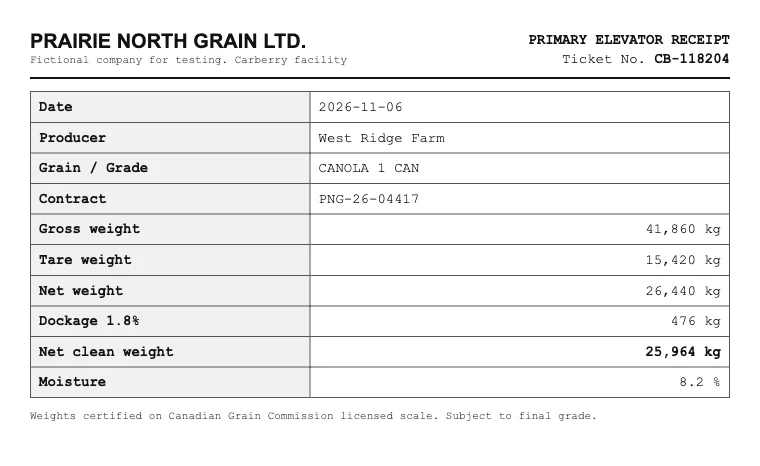
When the truck comes back, the ticket is the only record of that load until the settlement arrives, often weeks later. Write these down the same day, or take a photo, because some tickets are printed on paper that fades:
- Ticket number
- The buyer prints it on the settlement that pays for the load. It is how you will match the two.
- Date
- When the load was delivered. In Canada, if you disagree with the grade or the dockage at a licensed primary elevator, you can ask the Canadian Grain Commission for a Final Quality Determination within 7 calendar days of delivery, so the date sets your deadline.
- Crop and grade
- The grade the elevator gave the load. If it is lower than the grade on the contract, the price will be too.
- Gross, unload and net weight
- The loaded truck, minus the empty truck, is the unload weight. Dockage comes off that, and what is left is the net weight. On a licensed Canadian elevator's ticket, the price is per net tonne. Some tickets use "net" for the weight before dockage, so check yours.
- Dockage and moisture
- Dockage is weight taken off for material that isn't grain (what dockage is and what it costs). Moisture above the base for your crop costs shrink and often a drying charge; the shrink calculator works out how much.
- Contract number
- Which contract the load went on. If it isn't on the ticket, write it on.
Delivered is the sum of the tickets
What you have delivered on a contract is the weight after dockage on every ticket that went on it, added up. What is still owed is the contract quantity minus that. Don't keep a delivered figure you type by hand. After one missed load it no longer matches the tickets, and the tickets are what the buyer pays on.
The example above is a 120 tonne canola contract with three loads hauled:
| Ticket | Unload weight | Dockage | Net, after dockage |
|---|---|---|---|
| CB-118301 | 26,120 kg | 1.8% | 25.650 t |
| CB-118322 | 25,740 kg | 2.2% | 25.174 t |
| CB-118347 | 26,380 kg | 1.5% | 25.984 t |
| Delivered | 78.240 t | 1.432 t | 76.808 t |
So 76.808 tonnes are delivered, 64% of the contract, and 43.192 tonnes are still owed. At about 25.6 tonnes a load, that is two more loads, the second one partial. The 1.432 tonnes of dockage didn't fill the contract, which is why counting unload weight alone would have you short at the end of the window.
Matching tickets to the settlement
Settlements usually print the ticket numbers they pay for. Tick each one off your list:
- A ticket on no settlement is grain you haven't been paid for yet. After a few weeks, ask the buyer about it.
- The weight paid on should match the tickets after dockage. A gap the dockage doesn't explain is worth a question.
- The grade paid at should match the tickets. If it is lower than the contract, check the dates: the 7 days to ask for a Final Quality Determination run from each delivery.
The free settlement checker puts the contract, the tickets and the settlement side by side and splits the difference into price, weight and deductions. Tickets are step two of tracking a grain contract, between signing it and checking what you were paid.
In a spreadsheet, or in GrainPosition
A spreadsheet works if you add a row for every load, with its contract, and add up delivered from those rows rather than typing it. The free grain contract spreadsheet has the contracts and bins; put the tickets on a sheet of their own.
In GrainPosition, you take a photo of the ticket and the ticket number, date, weights, moisture, dockage and grade fill in for you to check. If the contract number is on the ticket, the load goes on that contract. Delivered and still owed come from the tickets, and when the settlement comes, the tickets it lists are matched to it. See a contract, a ticket and a settlement read from photos.
Questions
How do I work out how much I have delivered on a grain contract?
Add up the weight after dockage on every scale ticket that went on that contract. Three loads of 26.12, 25.74 and 26.38 tonnes unloaded, with 1.8%, 2.2% and 1.5% dockage, deliver 76.808 tonnes. On a 120 tonne contract, 43.192 tonnes are still owed.
What should I keep from each scale ticket?
The ticket number, the date, the crop and grade, the gross, empty and unload weights, the dockage, the net weight and the moisture, and the contract number the load went on. The ticket number is how you will find the load on the settlement, and the date matters if you want to dispute a grade.
How do I match scale tickets to a settlement?
Settlements usually print the ticket numbers they pay for. Tick each one off against your list. A ticket that never shows up on a settlement is grain you haven't been paid for yet, and a settlement weight that differs from the tickets after dockage is worth a question.
Does dockage count towards the contract?
Usually not. On a licensed Canadian elevator's ticket the price is per net tonne, the weight after dockage, and that is normally the weight that fills the contract. Check how your contract counts it. If your ticket shows only the weight after dockage, use that one.
Every load on the right contract
GrainPosition reads scale tickets from a photo, puts each load on its contract, and works out delivered and still owed from the tickets, in tonnes or bushels. Free during early access.
Have a lookSources and method
Method: each ticket's unload weight times (1 − dockage ÷ 100), added up, is what is delivered. Still owed is the contract quantity minus that, and loads left is still owed divided by the average delivered per load, rounded up. In kilograms mode, ticket weights are divided by 1,000 to compare with a contract in tonnes.
Grade and dockage disputes: the Canadian Grain Commission's Final Quality Determination (formerly "subject to inspector's grade and dockage") applies only to deliveries to licensed primary elevators in Canada, requested within 7 calendar days of delivery: How to request a Final Quality Determination, checked 3 October 2026.
Keeping this in a notebook, a spreadsheet or another app?
I’m setting up the books of the first 30 farms myself. I’ll import your spreadsheet, an export from the app you use now, or photos of your contracts, and set up your book in GrainPosition, so you can try it on your own numbers. Nothing is charged today, and nothing starts without your yes. See how it works in two minutes.