Grain bin inventory: what's in every bin, and what's unsold
List your bins and what's in them. This adds up each crop across the yard and, with what you still owe on contracts, shows how much is unsold. In tonnes or bushels.
Have a grain settlement on paper? Send me a photo and I’ll check it against your contract, free, within a day.
Each crop, and what's unsold
Put in what you still owe on each crop's contracts: the contract quantity minus what's delivered. Leave it at 0 if nothing is contracted.
| Crop | In the bins | Still owed on contracts | Unsold |
|---|
What to record for every bin
A bin inventory is one line per bin. Keep it the same way every year and it stays easy to read:
- Name and yard
- What you call it, and where it stands. "Bin 4, home yard" is enough, as long as everyone on the farm uses the same name.
- Crop
- One crop per bin. If a bin is split or blended, note it.
- How much is in it
- In tonnes or bushels, the same unit as your contracts.
- What it holds
- So you know how much room is left at harvest. The bin capacity calculator works it out from the diameter and height.
- Grade, moisture and protein
- What you know about the grain in it. This is what a buyer asks about, and it tells you which bin to haul for which contract.
- Last counted
- When you last measured it, and what you found.
The book says one thing, the bin another
On paper, a bin holds what went in minus every load that came out. In practice, the two drift apart: yield monitor and cart scale estimates, grain that dries down, a load written against the wrong bin. That is why it pays to measure the bins every so often and write down the gap between what the count found and what the book said, not just the new figure. A gap that keeps growing on one crop is worth finding before you sign a contract you can't fill.
It matters at the bank too. Operating loans are often secured against grain in storage, and the crop insurance production reports due in the fall (Nov 15 in Saskatchewan and Alberta, Nov 30 in Manitoba) ask what came off.
Unsold is what's in the bins minus what's still owed
For each crop, add every bin, then take off what you still have to deliver on that crop's contracts. What's left is unsold: the grain you can still market. If the number goes negative, you've contracted more than the bins hold, and the difference has to come from grain not yet in the bins or the contract will come up short.
In the example above, 760 tonnes of canola sit in three bins and 420 tonnes are still owed on contracts, so 340 tonnes of canola are unsold.
In a spreadsheet, or in GrainPosition
A spreadsheet works if you keep it up to date as grain moves. The free grain contract and inventory spreadsheet has a bin inventory sheet, with a column for the yard, next to the contracts, and works out how much of each crop is sold. It downloads straight away, with no email.
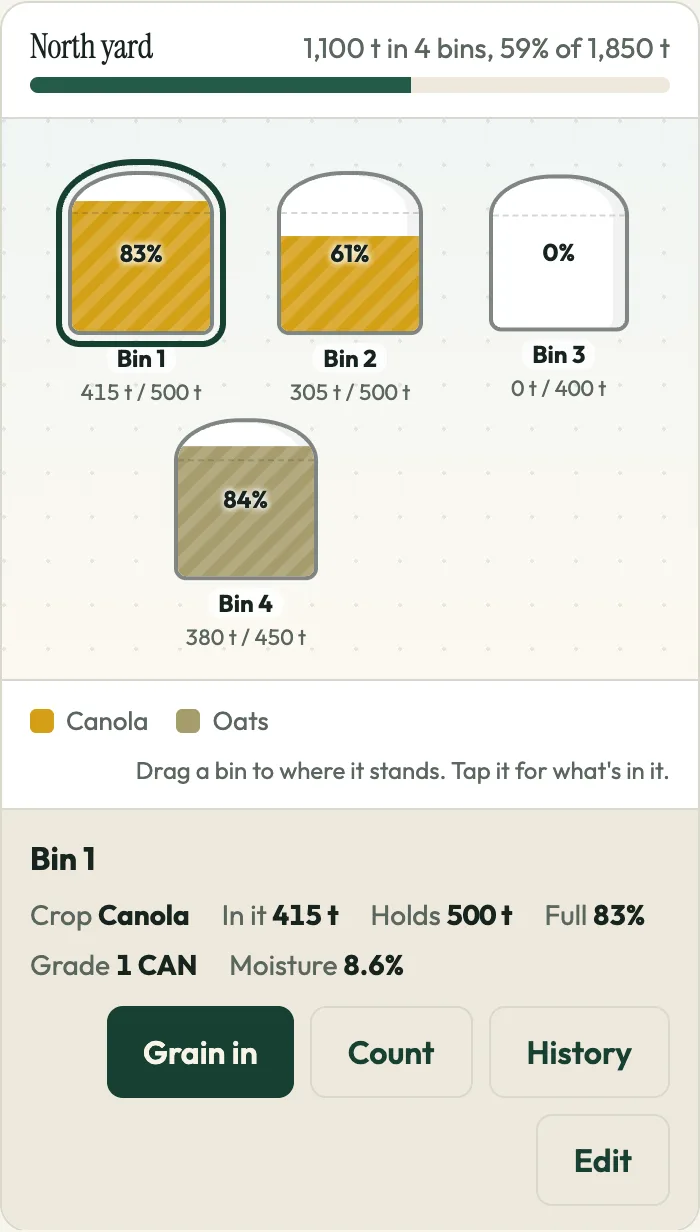
In GrainPosition, each yard is a map you arrange by dragging the bins to where they stand, and every bin or grain bag is filled to how full it is, in its crop's colour, with its grade, moisture and protein. Grain going in is recorded against the bin, and a load hauled out of a bin comes off it. When you count a bin, the gap against the book is kept, and the dashboard tells you when a crop's bins come up short. Every change is in the bin's history. Someone hauling for you can log loads and bins from their own phone without seeing prices, and the bank report lists every bin. The app also imports the spreadsheet.
Questions
How do I keep track of the grain in my bins?
Keep one line per bin: its name and yard, the crop, how much is in it, what it holds, and the grade, moisture and protein if you know them. Add grain as it goes in and take each load off the bin it came out of. Every so often, measure the bins and write down what the count found against what the book says.
How do I know how much grain I have unsold?
Add up each crop across all its bins, then take off what is still owed on that crop's contracts. What is left is unsold. With 760 tonnes of canola in the bins and 420 tonnes still to deliver on contracts, 340 tonnes are unsold.
Should I keep bin inventory in bushels or tonnes?
Use the unit your contracts are in, so what is in the bins and what is owed can be compared without converting. Canadian contracts are usually in tonnes and US contracts in bushels. If you need to convert, use the crop's bushel weight: a bushel of canola is 50 pounds and a bushel of wheat 60 pounds (bushels to tonnes, by crop).
Is there a free grain bin inventory spreadsheet?
Yes. GrainPosition's free Excel workbook has a bin inventory sheet next to the contracts, and works out how much of each crop is sold and at what average price. It downloads straight away, with no email needed, and the GrainPosition app can import it.
Every bin, on a map of your yard
GrainPosition keeps each bin's crop, amount, grade and moisture, takes loads off the bin they came from, and shows what's unsold against your contracts, in tonnes or bushels. Free during early access.
Have a lookSources and method
Method: each crop's amounts are added up across its bins. Unsold is that total minus what you put in as still owed on the crop's contracts; below zero, it shows how much more is contracted than is in the bins. Nothing is converted: put every amount in the same unit.
Bushel weights: the Canadian Grain Commission's standard bushel weights, used on the bushels to tonnes page.
Were you paid right on your last grain settlement?
Send me a photo of the settlement, and the contract if you have it. Within a day I’ll email you back what each line is, what’s worth asking the buyer about, and any grade or payment deadline that’s still open. Free, no account.
 Ruslan Glick, Winnipeg. Not a farmer, so I check against your contract and the grain rules, not opinions. Top Crop Manager wrote about GrainPosition.